How to Choose a Reliable Home Renovation Contractor in Maryland - 7 Things to Check
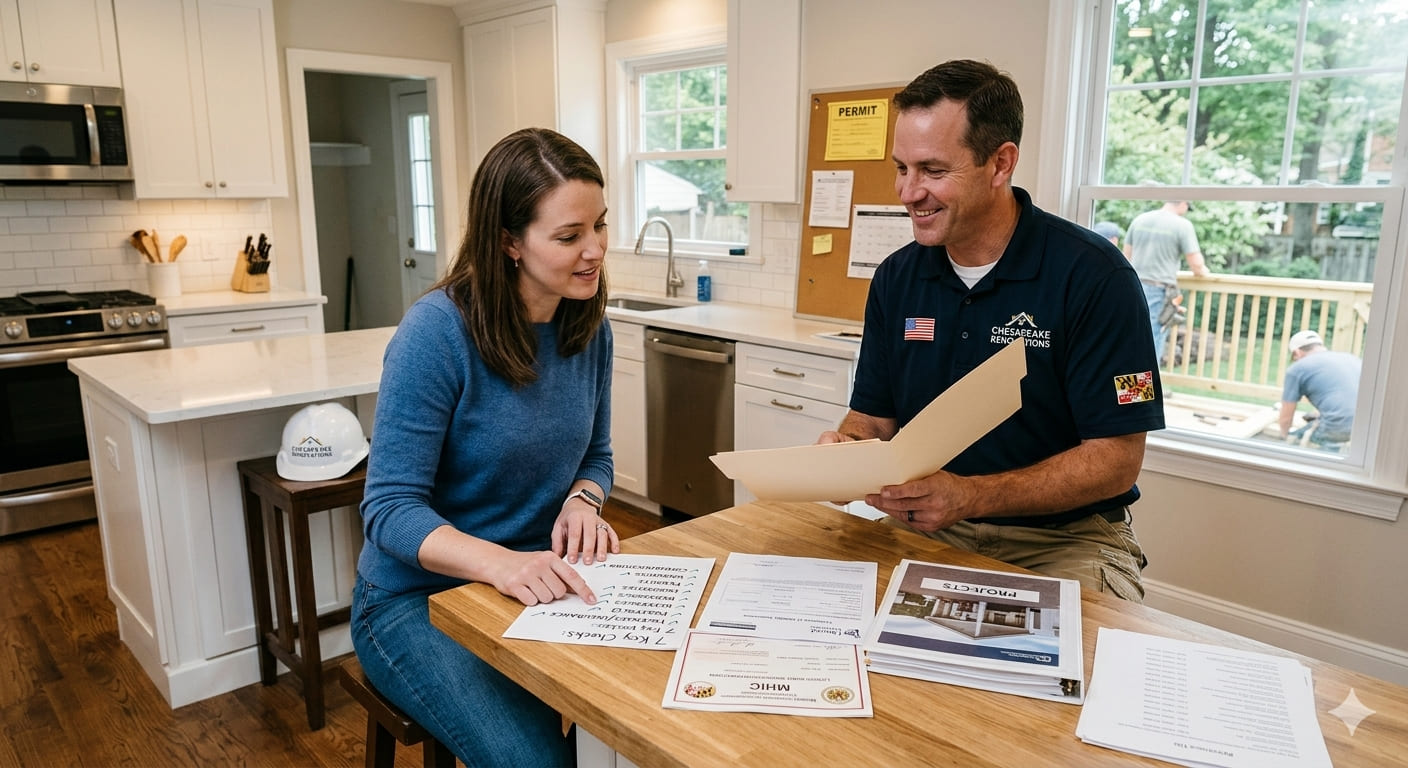
Quick Answer: To choose a reliable home renovation contractor in Maryland, start by confirming their MHIC license through the Maryland Department of Labor. From there: Verify insurance, call references, collect at least three written quotes, look at finished work, ask about permits, and read every line of the contract before you sign. If you skip any of these steps, you take on the risk that Maryland law specifically protects you from. |
Picking the wrong contractor is one of the costlier mistakes a Maryland homeowner can make. Not just financially, though that part is bad enough. It is the lost time, the arguments, the unusable, half-finished bathroom, and the inspector who shows up and fails work that should never have been done that way. These things happen more than most people think, and they almost always trace back to skipping the vetting process.
The Maryland home renovation contractor market has no shortage of capable professionals. It also has its share of unlicensed operators, lowball bidders who make up the difference later, and contractors who go quiet halfway through a job. The state actually has strong consumer protections built in, but they only help you if the contractor you hired was licensed to begin with.
This guide walks through the 7 things every Maryland homeowner must check before signing with any home improvement contractor. Everything here is based on state law, MHIC regulations, and the mistakes that renovation professionals in the DC, Maryland, and Virginia (DMV) area observe when homeowners skip steps.
Why Choosing the Right Contractor in Maryland Is More Critical Than Anywhere Else
Older housing stock, stricter permitting, and a real estate market where a renovation gone wrong follows you into the sale process. That is the Maryland context. A botched kitchen remodel in Montgomery County does not just cost money to fix. It can come back at the closing table, or worse, flag a code violation that has to be resolved before you can even list.
Here is what is actually at stake when the wrong contractor is on the job:
- Unpermitted work that has to come out before you can sell
- Structural or safety failures that your homeowner’s insurance may not cover
- Zero recourse through Maryland’s Guaranty Fund if the contractor was not licensed
- Change orders from contractors who underbid on purpose
- Failed inspections in Montgomery County, Prince George’s County, or Baltimore that require expensive rework
The 7 Things to Check Before Hiring a Home Renovation Contractor in Maryland
Check 1: Verify Their MHIC License (This Is Non-Negotiable)

Maryland law requires every contractor doing home renovation or improvement work in Maryland to carry an active Maryland Home Improvement Commission (MHIC) license. This is not optional. Under the Maryland Business Regulation Article, Title 8, work involving the alteration, remodeling, repair, or replacement of a residential property requires a license regardless of the dollar amount.
What does the license actually mean? The contractor passed the required exam, showed at least two years of home improvement experience, demonstrated financial solvency, and carries the minimum required insurance. They are also paying into Maryland’s Home Improvement Guaranty Fund. If they fail to finish the job or cause verified monetary losses, that fund can pay you back up to $30,000. That protection does not exist for unlicensed work.
How to verify a Maryland contractor’s MHIC license:
- Online: labor.maryland.gov/pq; search by contractor name or license number
- By phone: Call MHIC at 410-230-6231 or toll-free at 1-888-218-5925
- On documents and vehicles: Licensed contractors are required to show their MHIC number on all contracts, ads, and work vehicles.
- Disciplinary history: The same lookup shows complaints, suspensions, and any enforcement actions on file
Red Flag: Any contractor who cannot or will not give you their MHIC license number on request should not get the job. No license means no Guaranty Fund coverage and very limited legal options if the project goes sideways. |
Check 2: Confirm General Liability and Workers’ Compensation Insurance

The license alone does not cover everything. You need to verify insurance separately, and you need to do it yourself instead of relying on the contractor’s word.
As of June 1, 2024, Maryland requires MHIC contractors to carry at least $500,000 in general liability coverage. That figure was $50,000 previously, which means older certificates floating around may no longer be valid. Always ask for a current certificate and call the insurer directly to confirm the policy is active.
Why both types of coverage matter:
- General Liability Insurance: If the crew damages something, this policy is what pays for it. A ruptured pipe, a cracked wall, a broken window, none of that comes out of your pocket when coverage is in place.
- Workers’ Compensation Insurance: If a worker gets hurt on your property and the contractor lacks workers’ comp, you could end up liable. It is an uncomfortable situation that is entirely avoidable.
Action Step: Ask the contractor to have the certificate of insurance sent to you directly from their insurer. Not a copy they hand over. Not a PDF forwarded by email. Straight from the insurer to you. Then call and confirm. |
Check 3: Check References From Recent Local Projects

References are where a lot of homeowners go wrong. They ask for the list, receive it, and then never actually call. Do not do that. Those calls take fifteen minutes, and they provide information that no portfolio photo could ever convey.
A reputable home renovation contractor in the DMV area should hand over three to five recent references without hesitation. If they stall or offer vague contacts, that tells you something.
When you do make those calls, be sure to ask the specific questions:
- Was the project finished on time, and did it land within budget?
- What happened when something unexpected came up? How did the contractor handle it?
- Was communication reliable throughout, or did you have to chase updates?
- Were all the permits pulled and inspections passed without issue?
- Would you hire them again, without reservation?
- Was anything left unresolved after the job was done?
Also, look beyond the references they provide. Google Reviews, the Better Business Bureau, and Houzz all have unfiltered feedback. For Maryland-specific complaints, the MHIC records are searchable.
Try to get references from the past two years, ideally from your county. A contractor who has worked regularly in Montgomery County, Prince George’s County, Baltimore, or Northern Maryland knows the local permit office, the inspectors, and the subcontractor pool. That local knowledge directly affects your timeline.
Check 4: Get at Least 3 Detailed Written Quotes

Most homeowners get quotes to compare prices. That is the wrong goal. The goal is to compare the scope, materials, timeline, and how each contractor is thinking about your project. The price is determined by all of those factors. Give every contractor the same detailed description so you are actually comparing equivalent proposals.
A written quote from a professional home renovation contractor in Maryland should spell out:
- Scope of work, broken down room by room and task by task
- Specific materials, with brands, grades, and dimensions named
- Labor costs are shown separately from material costs
- Permit costs included, not hidden or listed as TBD
- Timeline with a start date, milestones, and a completion date
- Payment schedule tied to what has been completed, not to calendar dates
- Warranty terms covering both labor and materials
Beware of Lowball Bids: Under Maryland’s Home Improvement Law, a contractor cannot require more than one-third of the total contract price as a deposit. Anyone asking for 50% or more up front is either violating state law or very close to it. A dramatically low bid usually gets made up somewhere else, through change orders, cheaper materials, or uninsured subcontractors. |
A slightly higher number from a contractor with a strong local reputation will almost always be the better deal in the end.
Check 5: Review Their Portfolio of Completed Work in Your Area

Photos are helpful. Walking through an actual finished project is better. Ask to see work that is similar to yours, completed recently, by the same crew. A contractor who does a lot of kitchen remodels and bathroom renovations in Maryland will be a better fit for that scope than someone whose portfolio is mostly light handyman work.
In a portfolio, look for:
- Finished quality: clean lines, tight tile work, cabinetry that sits properly
- Local architectural familiarity: Maryland has a lot of colonial, craftsman, and split-level homes, and experienced contractors know how to work with them
- Material choices that hold up: humidity and freeze-thaw cycles are real factors in the DMV area, and the right contractor accounts for them
- Scale that matches yours: someone who mostly does small projects may not be the right fit for a full home renovation
For homeowners in the DC, Maryland, and Virginia area, DMV General Contractor maintains a projects portfolio of completed kitchen, bathroom, basement finishing, and whole-home renovation projects throughout the region. A good starting point is to look at local, finished work from a contractor who knows your market.
Check 6: Confirm Their Knowledge of Maryland Permits and Building Codes

This check often gets skipped and causes the most damage when it does. In Maryland, nearly every renovation that touches structural work, plumbing, electrical systems, or HVAC requires a permit. The specifics vary quite a bit by county.
| County / Jurisdiction | Key Permit Considerations |
|---|---|
| Montgomery County | Strict permit requirements, strong inspection enforcement, and parking restrictions in Bethesda and Rockville add logistical complexity. |
| Prince George’s County | Detailed review for structural work; specific requirements for older housing stock. |
| Baltimore City / County | Historic preservation rules for older neighborhoods; active inspection processes. |
| Northern Maryland | Regional building code applies; rural areas may have different timeline expectations. |
| DC (District) | DCRA permits required; rowhouse modifications need neighbor notification in some cases. |
| Northern Virginia (VA) | Separate state licensing required; Fairfax and Arlington have active inspection departments. |
Before hiring, ask your contractor:
- Will you pull all required permits? (Reliable contractors say yes, without hesitation.)
- What permits does this specific scope of work require in my county?
- How do you handle permit delays, which are fairly common in Maryland?
- Have you completed similar projects in this county before?
Never allow work without permits: Unpermitted renovations in Maryland can block your home sale, trigger code compliance orders, and void your homeowner’s insurance. If a contractor suggests skipping permits to save time or money, that is a reason to walk away, not a favor they are doing you. |
Check 7: Demand a Detailed Written Contract Before Any Money Changes Hands

Maryland’s Home Improvement Law says all renovation contracts must be in writing. That is the legal floor. A compliant contract and a useful contract are not the same thing. The contract you sign should cover the project in full, not just satisfy the minimum paperwork requirement.
A complete home renovation contract in Maryland covers:
- Contractor’s full name, address, phone number, and MHIC license number
- Detailed description of all work, room by room, and trade by trade
- Full materials list with brands, specifications, and quantities
- Total project price and an itemized breakdown
- Payment schedule tied to milestones, not to calendar dates
- Project start date and estimated completion date
- Change order process: how scope changes are priced and approved
- Dispute resolution process
- Warranty terms on labor and materials
- MHIC notice informing you of the Guaranty Fund and your rights as a homeowner
Maryland Law Reminder: The initial deposit is capped at one-third of the total contract price under Maryland’s Home Improvement Law. Many solid contractors will accept 10 to 15% at signing, with the rest tied to completed milestones. Hold the final payment until you have done a full walkthrough and you are genuinely satisfied. Once that final check clears, your negotiating position is gone. |
Your 7-Point Contractor Checklist at a Glance
Run through this before signing anything:
| # | What to Check | How to Verify | Status |
|---|---|---|---|
| 1 | MHIC License: Active and Valid | labor.maryland.gov/pq or call 410-230-6231 | Verified |
| 2 | General Liability ($500K+) and Workers' Comp Insurance | Request certificate; call the insurer directly | Verified |
| 3 | References from Recent Local MD Projects | Call 3+ references; check Google, BBB, Houzz | Verified |
| 4 | At Least 3 Detailed Written Quotes | Compare scope, materials, timeline, not just price | Verified |
| 5 | Portfolio of Completed Work in Your Area | Request photos or arrange a site visit | Verified |
| 6 | Permit Knowledge for Your County | Ask which permits are needed, the process, and the timeline | Verified |
| 7 | Detailed Written Contract | Review every required element before signing | Verified |
5 Contractor Red Flags to Watch Out for in Maryland
The checklist tells you what to look for. These are the signals that should end the conversation:
- Will not or cannot provide their MHIC license number, no exceptions, ever
- Demands more than one-third of the total cost upfront, which is illegal under Maryland law
- Suggests skipping permits to save time or money; that risk is yours to carry, not theirs
- Cannot provide local references from work done in the past year or two
- Pressures you to decide immediately that any contractor worth hiring respects a homeowner’s due diligence
- Hands you a vague, one-page, or handwritten "contract"; professional agreements are detailed and specific
- Comes in dramatically below every other bid; that gap has to come from somewhere
What to Look for in a General Contractor for Your Maryland Home Renovation?
Beyond the checklist, certain qualities show up consistently in contractors who deliver strong results. None of them is hard to spot once you know what you are looking for.
Local DMV Market Knowledge
Maryland and the DMV area renovations have specific realities. Montgomery County's permit office runs differently from Baltimore’s. Materials that work well in dry climates can fail in the Mid-Atlantic humidity. A contractor with real, recent experience in your county brings that context to every decision they make on your project. It is not a soft benefit.
Clear, Proactive Communication
Multi-week renovations involve many different aspects. The contractors who stand out are the ones who tell you what is happening before you have to ask. Written updates, quick responses, and honest answers make the difference between controlling your project and being surprised by it.
Transparent Pricing With No Hidden Costs
Good contractors price accurately upfront. Change orders should be exceptions and always documented and approved before work proceeds. If your final invoice looks nothing like your original quote, something went wrong in the bidding process, and it usually was not accidental.
Established Subcontractor Relationships
Plumbing, electrical, and HVAC work almost always involves subcontractors. A reliable general contractor uses the same vetted, licensed, and insured subcontractors across multiple projects. They know the quality of the work, and they stand behind it. Ask who the subs are and verify that they hold Maryland licenses before anything starts.
Frequently Asked Questions
Final Thoughts: Take Your Time; Your Home Deserves It
Hiring a reliable home renovation contractor in Maryland is not a decision to rush. The ones who come out well took a few extra days to run the checks, call the references, and read the contract. The process described in this guide is not complicated. It just requires doing it.
The 7 Non-negotiable Checks:
- Verify their MHIC license at labor.maryland.gov/pq
- Confirm $500K+ general liability and workers’ compensation insurance.
- Check references from recent Maryland projects and actually make the calls.
- Get at least 3 detailed written quotes covering the same scope.
- Review their portfolio of completed work in your area.
- Confirm permit knowledge for your specific county.
- Get a detailed, legally compliant written contract before any money moves
If you are looking for a trusted, MHIC-compliant general contractor in Maryland, DC, or Northern Virginia, the team at DMV General Contractor brings years of experience across kitchen remodels, bathroom renovations, basement finishing, and whole-home renovations throughout the DMV area. Fully licensed, insured, and committed to clear communication from the first conversation through the final walkthrough.
Ready to Get Started?
Contact DMV General Contractor today for a free, no-obligation consultation. We will walk through your project, put together a transparent written quote, and show you finished work from right here in Maryland, DC, and Virginia.
Ready to upgrade your home? Call us at 240.730.1292 for a free, no-obligation consultation and a clear estimate tailored to your home.
Book a free consultation!